
Inspect Your Deck in 30 Minutes
You do not need to hire an inspector to get a clear picture of your deck's condition. A screwdriver and 30 minutes will tell you most of what you need to know.
Phase 1: Structural Assessment
Probe the posts at ground level with the screwdriver. If the tip sinks easily or the wood feels soft and spongy, that post has rot. Do the same on the main beams. Check the ledger board, the horizontal piece that attaches the deck to your home's rim joist, by pressing firmly along its length. Ledger rot is particularly serious because a failed ledger can cause the entire deck to detach from the house.
Phase 2: Surface Boards
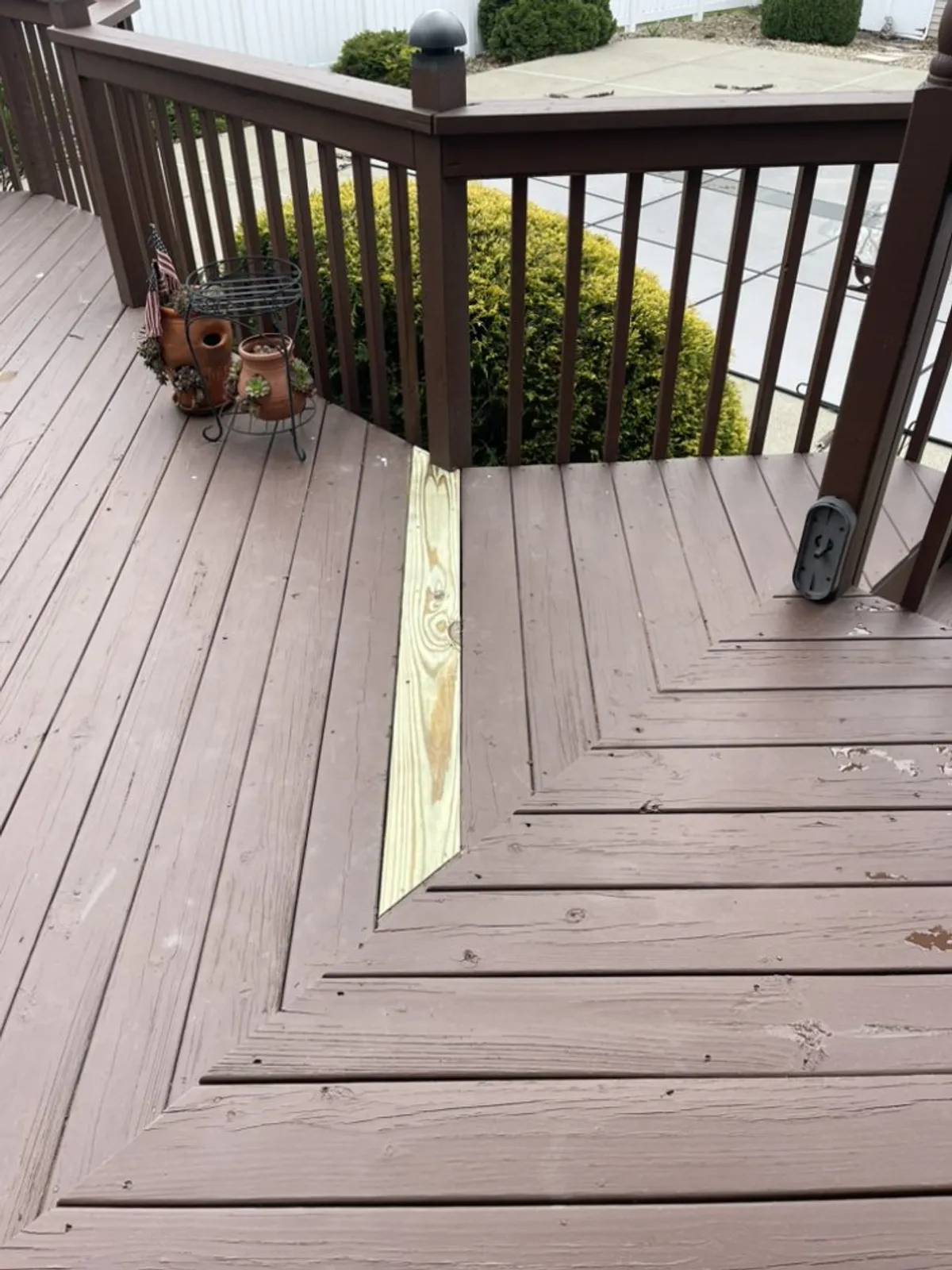
Walk the deck slowly, feeling for flex or give underfoot. One or two soft spots likely indicate isolated board rot. If the boards feel spongy in multiple areas across the deck, rot has spread and the scope expands significantly.
Phase 3: Connection Points
Look at the joist hangers (the metal brackets holding the joists). Rust and corrosion here weakens structural connections. Check that the guardrail posts feel rigid when you push against them, any significant wobble is a code issue and a safety concern.
What you find in those three phases tells you whether you are looking at a $400 board swap, a $2,000 targeted repair, or a $12,000 replacement.
The 50% Rule: The Industry Standard for Repair vs. Replace
Here is the cleaner framework contractors use:
If the cost to repair exceeds 50% of the cost to replace, replace.
This rule exists for a good reason. At the 50% threshold, you are spending significant money on a structure that is already aging, with no warranty, no material upgrade, and no reset on the structural clock. You get the cost without the value.
Below 50%? Repair almost always makes sense, especially if the deck is under 10 years old and the structure is sound.
Above 50% or any sign of structural compromise? Replacement is the honest path forward. This is not just a financial calculation, it is a safety one.
7 Signs Your Deck Needs to Be Replaced
1. Widespread rot in structural members. Rotted posts, beams, or ledger board cannot be patched. Once structural wood has lost integrity, it needs to come out.
2. Soft spots in multiple areas across the surface. Isolated soft boards can be swapped. Widespread softness means the decking material has failed across a large area, at that point, full surface replacement often costs almost as much as a full rebuild.
3. The deck is over 20 to 25 years old. Pressure-treated wood decks have a lifespan of roughly 20 to 25 years depending on maintenance and climate. Western Pennsylvania's freeze-thaw cycles accelerate deterioration. An aging deck near or past this threshold is worth replacing before it fails.
4. It no longer meets current building code. Older decks frequently have railing heights, baluster spacing, or footing depths that do not meet current PA building codes. A deck that fails inspection cannot be legally used and must be brought into compliance, which often means replacement.
5. Wobbly guardrails that cannot be secured. Guardrail failure is the most common cause of deck-related injuries. If posts cannot be stabilized through standard fastening, the structural connection below has failed.
6. Significant ledger board damage. The ledger is the most critical structural element. Any meaningful rot or separation here is a replacement-level concern.
7. Boards that no longer take stain or finish. When wood has been sanded and cleaned but still will not accept a finish, it has reached the end of its useful life. Continuing to apply product over dead wood is a wasted investment.
Signs Your Deck Can Be Repaired (And Worth Saving)
Your deck is worth repairing if:
The structure, posts, beams, ledger, and joists, is solid when probed. Isolated board damage (3 to 5 boards or fewer) can be addressed surgically. The hardware shows surface rust but the connections themselves are tight. The railings are stable and meet current code height requirements. The deck is under 10 to 15 years old with a good maintenance history.
A deck with solid bones and surface wear is an excellent repair candidate. You can replace individual boards, apply a fresh stain or solid-color deck coating, and add another 8 to 12 years to the structure's service life at a fraction of replacement cost.
Did You Know?
Wooden decks offer an average 52.4% ROI at resale, and composite decks offer 39.8% ROI nationally, according to Remodeling by JLC's Cost vs. Value Report. (Source: Angi)
For an accurate assessment of your deck and a detailed replacement quote, reach out to Hammer Home Service for a no-obligation consultation.
The Partial Replacement Option
There is a third path that often makes the most financial sense: partial replacement.
If your deck's structure, posts, beams, joists, and ledger, is solid, but your surface boards and railings are failed, replacing only those elements saves a significant portion of full replacement cost. A structural deck frame in good condition can support new decking material for another 15 to 25 years.
Partial replacement also gives you the opportunity to upgrade from pressure-treated wood boards to composite decking on an existing frame, dramatically reducing future maintenance without the full cost of a complete rebuild.
Common Mistakes Homeowners Make
Applying deck coating over structural rot. Deck resurfacer products like Rust-Oleum Restore work well on cosmetically rough but structurally sound boards. Applied over rot, they are cosmetic masking with a 1 to 2-year life before failure. Probe first, coat second.
Skipping the permit for replacement. Deck replacement in Pennsylvania requires a building permit in virtually every municipality. Unpermitted decks fail home inspections at resale and can require costly removal or re-inspection.
Focusing only on surface appearance. A deck that stains beautifully is still dangerous if the ledger or posts are compromised. Do not let a fresh coat of finish convince you that structural issues can wait.
Waiting until the deck is unsafe. Deferred maintenance accelerates deterioration. A deck that needed $800 in board repairs at year 15 can become a $12,000 replacement by year 20 because surface water infiltrated joists that were otherwise salvageable.
FAQ
How do I know if my deck needs to be replaced or just repaired?
Start with a structural probe. Use a screwdriver to test posts, beams, and ledger board. If the structure is solid, surface damage is almost always repairable. If structural members show rot, replacement is the right path. Use the 50% rule: if repair costs exceed half the replacement cost, replace.
How long does a deck last in Western Pennsylvania?
Pressure-treated wood decks in Western PA typically last 15 to 25 years with regular maintenance. Pittsburgh's freeze-thaw cycles and wet springs accelerate weathering. Composite decks last 25 to 30+ years with minimal maintenance.
What is the 50% rule for deck replacement?
If the estimated cost to repair your deck exceeds 50% of the cost to replace it, replacement is the more financially sound decision. At that threshold you are spending substantial money on an aging structure without getting a warranty, material upgrade, or structural reset.
Can I replace deck boards without replacing the whole deck?
Yes, if the underlying frame, joists, beams, posts, and ledger, is structurally sound. Partial replacement (surface boards and railings on an intact frame) is often the best value option and can extend the deck's service life by 15 to 25 years.
Is composite decking worth the extra cost?
For homeowners planning to stay 10+ years, yes. Composite's near-zero maintenance requirement and 25 to 30+ year lifespan make it less expensive on a lifecycle basis despite the higher upfront cost. For near-term resale, quality pressure-treated lumber is the more practical choice.
What time of year is best to replace a deck in Western PA?
Late spring through early fall is ideal. Concrete footings need temperatures above 40°F to cure properly, which rules out most of Western PA's winter months. Booking in late winter or early spring secures your place in contractors' schedules before the summer rush.